
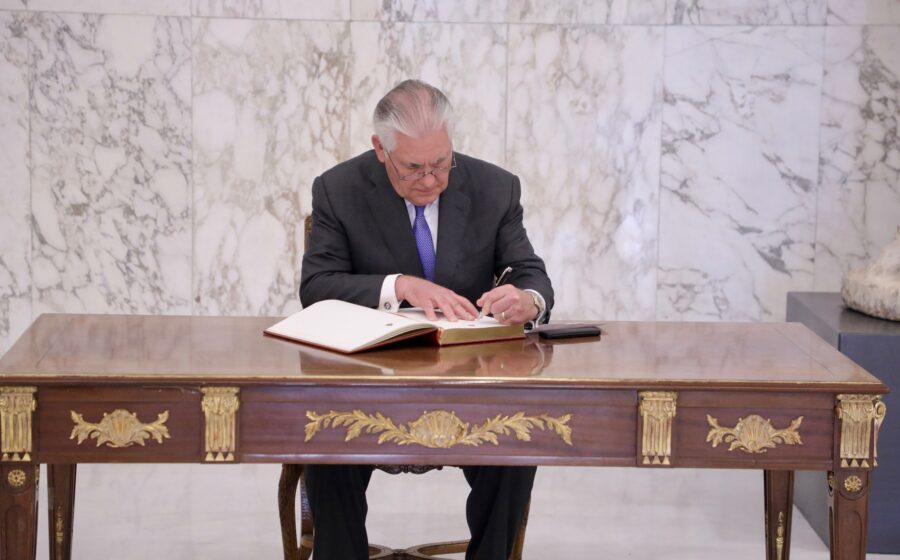
US Secretary of State Marco Rubio has urged Lebanese President Joseph Aoun not to hand back explosives seized from Hezbollah last week, and criticised Lebanon’s 1955 law banning contact with Israelis.
Washington has stepped into the dispute over a shipment of explosives intercepted by Lebanese authorities on its way to Beirut, with Secretary of State Marco Rubio telling President Joseph Aoun that returning the material to Hezbollah should not be an option.
The two men spoke by phone on Thursday, 15 October, according to a State Department official quoted by Axios, The National and Reuters.
“Out of the question”
According to the US official, Rubio told Aoun that handing the explosives back to Hezbollah “should be out of the question”. He also urged Lebanon to hold accountable everyone who ordered, financed and directed the shipment, the official said.
The cargo was stopped last week on a road linking eastern Lebanon’s Bekaa Valley to the capital, according to Axios and Asharq Al-Awsat. Reports differ on its size: Axios cited Lebanese officials as putting it at about 780 kilograms, including TNT and C-4, while Asharq Al-Awsat cited a judicial source speaking to AFP who described 500 kilograms, split equally between TNT and C-4.
Hezbollah wants its cargo back
In a rare acknowledgement, Hezbollah has said the explosives belonged to it. Asharq Al-Awsat quoted Hezbollah MP Hassan Fadlallah as saying “the vehicle and its cargo belong to the resistance”, and the group has called for the shipment to be returned and for those detained over the seizure to be released, according to both Axios and Asharq Al-Awsat. Axios reported that Hezbollah said the material was intended for use against Israeli forces in southern Lebanon.
Aoun’s response
According to the Lebanese presidency’s account, as reported by Axios and Asharq Al-Awsat, Aoun told Rubio that the army and security forces were fully carrying out their duties to prevent armed displays, seize weapons and ammunition and combat smuggling, and that the judiciary would show no leniency towards those responsible.
Aoun also asked Washington to press Israel to halt its strikes in southern Lebanon and to allow farmers to reach their fields, the same sources said. Israel says its operations target Hezbollah.
The 1955 boycott law
Rubio also raised Lebanon’s 1955 Boycott Law, which bars dealings with Israelis, according to Axios and The National. The State Department official said Rubio told Aoun the law is routinely used for politicised prosecutions that discourage steps towards peace with Israel.
The issue came to the fore after a lawyer filed a complaint against Lebanon’s ambassador in Washington, Nada Hamadeh Moawad, over an alleged contact with her Israeli counterpart, Yechiel Leiter, after his son was wounded in an attack in the occupied West Bank. The State Department called it “embarrassing” that the case was being handled by Lebanon’s military court, according to The National and Arab News.
A stalled framework
The exchange comes as implementation of a framework agreed in June moves slowly. The arrangement provides for the Lebanese state to extend its authority and disarm non-state groups, including Hezbollah, while Israel gradually withdraws from Lebanese territory, according to The National and Arab News.