
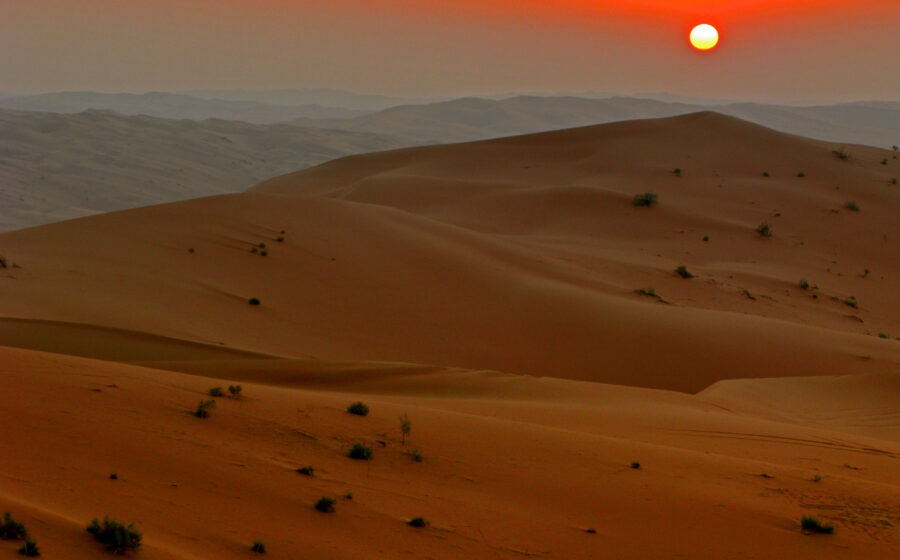
Early humans made flint tools, processed plants and may have used toxic plant compounds for hunting on the shore of a vanished lake in Saudi Arabia’s Empty Quarter some 125,000 years ago, according to a study published in the journal Science and announced by the Saudi Heritage Commission on 13 November.
A freshwater lake where dunes now stand
The site, Uruq al-Julaybah, lies on the former shoreline of the Mundafan palaeolake in Najran Region, within the Rub’ al-Khali in southern Saudi Arabia. Using satellite terrain modelling, the researchers estimate that the lake covered about 340 square kilometres and was up to 29 metres deep. Sediments and the remains of aquatic organisms point to a fairly stable body of fresh water surrounded by grassland and vegetation.
Dating places the occupation in the Last Interglacial, a warm and wet phase that scientists often describe as “Green Arabia”. The work was led by the Heritage Commission with King Abdullah University of Science and Technology (KAUST) and Australia’s Griffith University, alongside King Saud University and other institutions. Fieldwork was carried out during the 2023 season.
Hippos, buffalo and thousands of flint tools
Across more than 130 locations, the team documented over 500 fossil specimens. They include hippopotamuses, an extinct long-horned buffalo, camels, Arabian oryx, gazelles and ostriches, as well as molluscs and freshwater crustaceans known as ostracods.
Researchers also recovered 5,511 stone artefacts larger than two centimetres from the main study area. More than 98 per cent were made of flint, and many were shaped with the Levallois technique, a Middle Palaeolithic method in which a core is prepared in advance so that the maker can control the size and shape of the flakes and points struck from it. Refitting analysis showed that the tools were both produced and used on site.
Plant residues and a possible hunting poison
Microscopic and chemical analysis of tool surfaces revealed residues of plant fibres, wood, resins, fats and collagen, along with traces of palm and woody plants. Some points carry impact fractures and signs of hafting, suggesting they were fixed to handles or shafts.
Tests also detected compounds associated with Acokanthera schimperi, a plant traditionally linked to hunting poisons. The authors stress that the evidence cannot show how the material was prepared, in what concentration or how effective it was. KAUST describes the find as among the first such evidence recorded in Saudi Arabia.
“The combination of animal remains, stone tools and plant material in a single, dated context is what makes this discovery so significant,” Professor Chris Clarkson of Griffith University said in the university partners’ statement.
A climate archive in one of the driest places on Earth
The site matters as much for its environmental record as for its artefacts. The Empty Quarter is today among the most arid regions on the planet, yet the Mundafan fossils show that the same landscape once sustained large animals that need permanent water.
Dr Salma Hosawi, a professor of ancient history at King Saud University, told Arab News that such findings help researchers “reassess the history of the Arabian Peninsula”. She said the evidence points to repeated occupation over successive periods, with shifts in climate shaping where people settled and how they moved.
The results add to research presenting the peninsula as a region that early humans inhabited during wet phases, rather than a corridor they simply crossed. Saudi researchers also cite footprints more than 120,000 years old found beside ancient lakes in Tabuk.
Heritage research as a national priority
The Heritage Commission oversees and funds archaeological surveys in the kingdom. Its director general for antiquities, Dr Ajab Alotaibi, said the project reflects a commitment to multidisciplinary partnerships between Saudi and foreign universities, according to the Saudi Press Agency as reported by Asharq Al-Awsat. KAUST says it is building “heritage science” capabilities in the country.
The paper, titled “Poisoned hunting weapons, megafauna and plant use at a 125,000-year-old Arabian paleolakeshore”, is published in Science under the reference DOI 10.1126/science.aef9342.
Read more
 What is a hot summer?August 28, 2026
 June Heatwave: Highest Excess Mortality Since 2003August 1, 2026
 Saudi Arabia’s Voluntary National Review ties sustainability to Vision 2030’s final yearsJuly 14, 2026
 CarbonSifr and Careem Launch Eco-Friendly Rides in Saudi Arabia with Transport General Authority and MEWA’s Sedrah Program, supporting MEWA’s tree planting projects.January 6, 2025