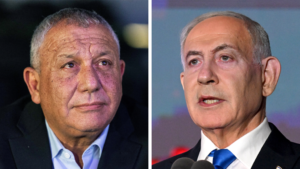
Standfirst: Israeli President Isaac Herzog announced late on Saturday, November 7, that he will entrust former army chief Gadi Eisenkot with forming the next government, passing over Prime Minister Benjamin Netanyahu after a week of consultations, according to the presidency as reported by AFP, Al Jazeera and The National. Eisenkot is due to receive the mandate formally on Sunday evening at the President’s Residence in Jerusalem.
67 lawmakers behind the challenger
The decision follows the inconclusive general election of October 27, in which neither camp secured a majority in the 120-seat Knesset. During Herzog’s consultations, factions representing 67 lawmakers recommended Eisenkot, the leader of the Yashar party, while factions representing 46 lawmakers backed Netanyahu. The seven members of United Torah Judaism endorsed no one, The National reported.
Netanyahu’s right-wing and religious coalition lost its parliamentary majority in the vote, although his Likud party remained the largest single list with 27 seats. Eisenkot’s four-party alliance won 48 seats, according to Al Jazeera, while Arab-led parties obtained a record 19 seats, split between the Joint List and Ra’am.
Once he holds the mandate, Eisenkot will have 28 days to assemble a government able to command at least 61 votes. Herzog may extend that period by up to 14 days. If he fails, the president can hand the task to another lawmaker; if that attempt also fails, Israel would head to a new election, with Netanyahu remaining caretaker prime minister in the meantime.
A call for a national emergency government
Shortly after Herzog’s announcement, Eisenkot wrote on X that “now is the time to form a national emergency government” and pledged to do everything he could to live up to the responsibility, according to Anadolu Agency and AFP. A day earlier he had described replacing Netanyahu as urgent, calling the prime minister a threat to Israeli democracy.
Netanyahu responded in a prerecorded video that a government relying on the Arab parties, which he described as Islamists, would “dismantle the state of Israel from within”. He called instead for a unity government of what he termed all the Zionist parties. The opposition has so far insisted that he step aside first; Eisenkot has previously ruled out serving under him.
The Arab parties dilemma
The support of Arab-led lists was decisive in giving Eisenkot the larger number of recommendations, but it also complicates his task. He has ruled out bringing those parties into a formal coalition, and several of his potential partners oppose depending on their votes. Former defence minister Avigdor Liberman has said he will not sit in a government that relies on Arab lawmakers, AFP reported.
Ahmad Tibi of the Joint List, which holds 11 seats, told Al Jazeera that Herzog’s choice was “expected”. He said he anticipated a minority government with outside support from Arab parties, while voicing concern about a possible national unity arrangement between Eisenkot and Netanyahu. Naftali Bennett, now part of Eisenkot’s alliance, previously led a government that relied on Ra’am’s support in 2021.
Possible paths to 61 seats
Reporting by Al Jazeera and The National points to three main scenarios. The first is a minority government backed from outside by Arab lawmakers. The second is a deal with the ultra-Orthodox parties: adding United Torah Judaism and Shas to Eisenkot’s bloc would give him exactly 61 seats. The third is a broad unity government including Likud.
The ultra-Orthodox option hinges on the contentious question of military service exemptions. Eisenkot has proposed national service for all Israelis, with a civilian track as an alternative to the army, which could open a door for ultra-Orthodox participation. On Friday, Liberman said he was open to discussing legislation enshrining an exemption, a reversal of a core campaign position he had shared with Bennett.
Eisenkot, who commanded the Israeli military from 2015 to 2019, sat as an observer in Netanyahu’s war cabinet during the first months of the Gaza war. Herzog, whose role is largely ceremonial but decisive at this stage, has signalled interest in a government spanning the political spectrum. Israel held five elections between 2019 and 2022 amid repeated deadlocks.